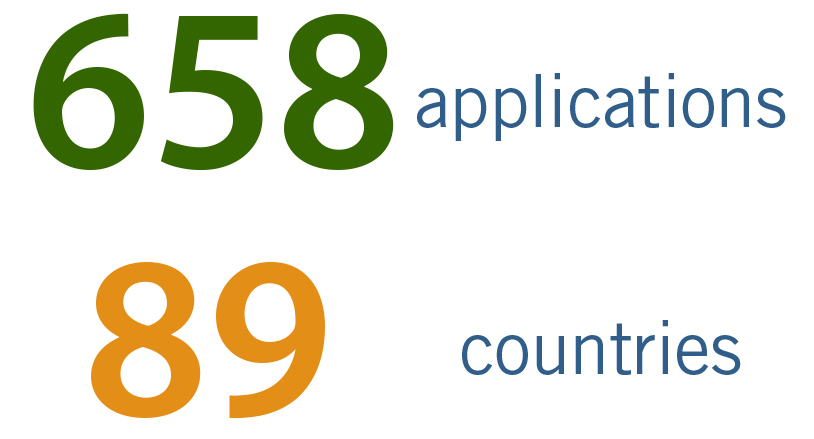
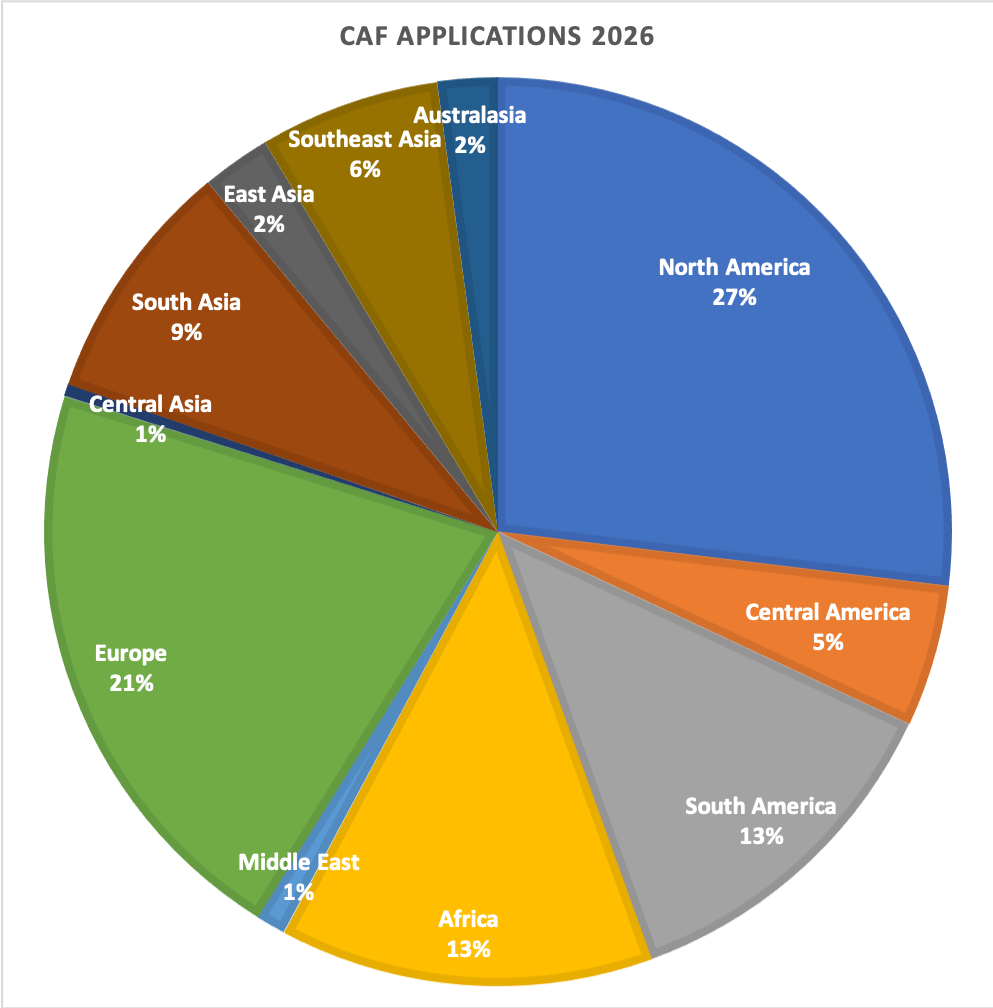
From Austin, Texas, to Swellendam in the Western Cape of South Africa; from Hyderabad, India, to Ibadan, Nigeria; from Manila in the Philippines to Buenos Aires, Argentina; from Kota Bagor, Indonesia, to Morelia, Mexico; from Berlin, Germany, to South Kivu in the Democratic Republic of Congo; from the largest landmasses in the world to a tiny island in Oceania and all points in-between you applied.
You wanted to protect Indigenous knowledge of ancestral animals, and employ the latest technology to understand and improve the welfare of the endangered and exploited creatures of today. You sought to gather contemporary writing about animals, or stage performances to embody them. You wanted to map their movements, create music alongside them, depict and take images of them. You were poets, authors of speculative fiction, flutists, guitarists, performance artists, dancers, aerialists, ceramicists, sound designers, curators, painters, dramaturges, muralists, and filmmakers. You were lawyers, anthrozoologists, historians, data analysts, critical theorists, feminists, ecologists, biologists, cognitive ethologists, climatologists, ethicists, and policy experts. And you were passionate about insects and whales, primates and plankton, elephants and minnows, street dogs and animals in a war zone, the heavily trafficked or mass produced, and the rare and misunderstood.
You were individual scholars and artists, collectives and dance companies, associations of advocates and conservationists, professors and undergraduates, street activists and workers for social justice. You carried with you a fierce urgency to protect, save, and preserve the other-than-human world amid the polycrises of biodiversity collapse, climate change, cultural destruction, social atomization, the spread of autocracy, and wisdom and genuine knowledge being replaced by a flood of (dis) or (mis)information.
We at CAF find ourselves in multiple forms of overwhelm. Not only, as the above suggests, has the range and variety of applications and the disciplines they come from massively increased over the last ten years, but so has the volume. In 2015, we received 40 applications and were able to fund 12 of them—and virtually all of them were from the United States. In 2020, the applications had risen to 130 and we were able to fund 14. By 2025, the number had risen to 235, and even though we had doubled the amount of money available for grants from a decade earlier, we could still only grant 15, since the costs of the grants had risen. This year, we’ve raised the amount we’re providing by 20 percent, but with 658 applications (2.8 times more than the year before), with three-quarters coming from outside the United States, the simple fact is that only one in 40 applicants will receive a grant.
That last statistic satisfies neither applicants nor us. We at CAF need to think deeply how best to serve this massive and diverse constituency and find a solution in addition to the obvious one (to have more cash on hand to provide grants) to close the discrepancy between the number of applications we receive and the number of grants we can provide. We take that as a challenge, yes, but it’s also a sign of hope: that everywhere on this planet and among a huge diversity of constituencies, people care about their fellow creatures and want to make a difference. It’s up to all funding organizations to ensure that that care is supported.