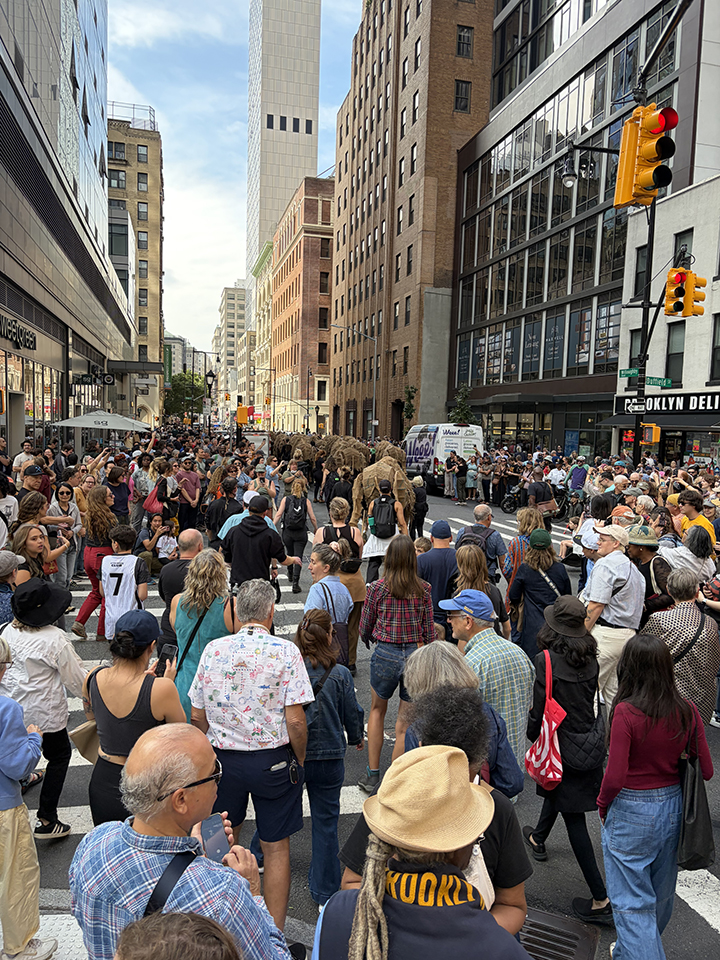
CAF Executive Director Martin Rowe and advisory board member Mia MacDonald unpack the meaning of American bison on the streets of New York City.
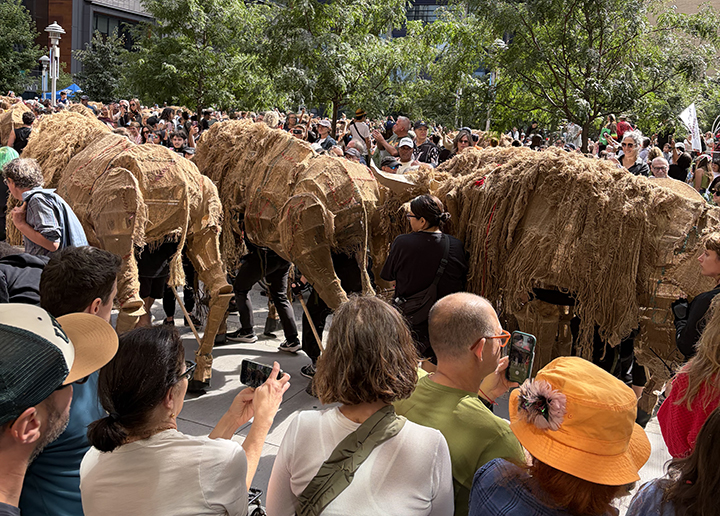
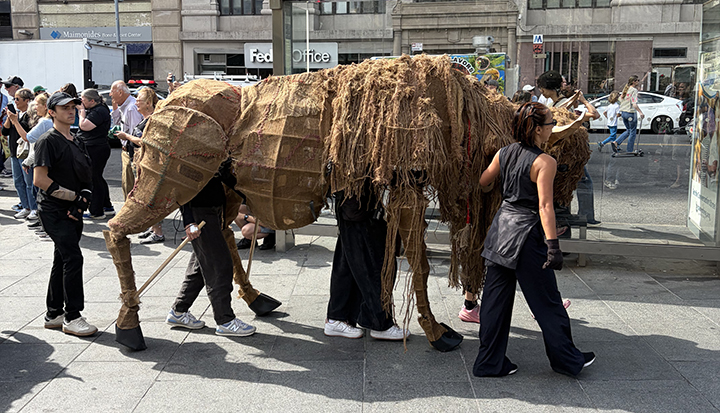 Those of us who attended Return of the Buffalo: Tatanka Owe Akupi as it wended its way from Abolitionist Park through Brooklyn Heights and into Brooklyn Bridge Park on Saturday September 19 experienced an unusual sensation: delight. This joint venture of St. Ann’s Warehouse and The Walk Productions involved 40 life-sized buffalo puppets, masterfully co-created by Amir Nizar Zuabi and elders from the Lenape and Lakota peoples, as well as (on route) choirs and performers such as Honk NYC! and Rhiannon Giddens.
Actually, “attended” doesn’t really describe what this was. We were in a parade, in that hundreds of us followed the animals, each puppet animated by as many as five artists operating the legs, torso, and head (left). We were enacting a ritual that transformed the urban space into echoes of an ancient pathway, carved out by the first nations, both human and nonhuman, who once traversed this continent. And we were engaged in an act of reconstitution, re-membering the bodies of those whose deliberate slaughter by the American government had eviscerated the economic, spiritual, and ecological bodies of the Plains nations to clear the land for white settlers.
Yet there was nothing burdensome about the historical, cultural, and imaginative currents that accompanied the bison (which would be their technically accurate name) as they flicked their heads, kicked their back legs, and majestically strode through the streets and down to the piers. Unlike the pell-mell harassment of those who chase the bulls in Pamplona, these buffalo led us, their transported admirers. Unlike the narcissists who pose for photos in front them in Yellowstone, we had no need to be center stage. The animating magic of art metamorphosed these puppets both into individual characters and into the essence of the creature itself: dignified, hardy, resilient; a teacher and guide from the past to direct us to a possible future.
Although not officially part of Climate Week NYC, Return of the Buffalo: Tatanka Owe Akupi (the Lakota words mean “buffalo trail home”) offered a timely reminder of how much two and a half centuries of environmental and civilizational destruction have cost humanity: the loss of ancient knowledge at the very moment when it is most needed; denuded and vulnerable monocultures instead of a rich biological and cultural diversity; and the virtual extinction of those who sustained entire nations and the vast lands of the prairies before they were wiped out in favor of cattle—that literal embodiment of capital, commodification, and colonial extractivism.
 Of course, that destruction continues. Some 80,000 bison were killed for meat in the U.S. in 2023. If any of the 5,000 Yellowstone buffalo venture outside their enclave, they may be killed, lest they spread brucellosis to cows. As one worker for the Buffalo Field Campaign told us many years ago, he’d seen people lined up in their pick-up trucks, their guns loaded. The buffalo were not difficult targets. “It’s like shooting a sofa,” he said. Even some guardians hold an instrumental view of the bison. When in the 1990s we learned about the reintroduction of the bison into Yellowstone with the Predator Conservation Alliance (now called People and Carnivores), a conservator informed us that the bison “have to pay their way.” That means meat.
We find ourselves in a time of atomization, rapacity, and cynicism. Notions of the common good, the beloved community, or even the extended circle have been suborned to the machine, to might equaling right, and the accumulation of obscene wealth by autocrats and oligarchs who are preparing to remove themselves to their bunkers when destruction comes to humankind and Earth. As we walked alongside the puppets, it seemed to us there was almost a physical wish to reconnect with each other and the natural world, a yearning to rebind our humanity to the animals and to the wildness and freedom that all embodied beings deserve. They were reminders that before we handed over our hearts and minds to technology, we once shaped things with our hands and imagined the animals had something to teach us. That weekend we glimpsed (however briefly) the possibility that the animals were no longer simply totems of a vanished past or passing curiosities, but what they could be if we just let them walk among us again: an enchantment.