CAF Executive Director, Martin Rowe, reflects on CAF’s four decades in his Introduction to the 2025 Annual Report.
Forty years ago this year, Tom and Nancy Regan gathered some friends at their home in Raleigh, North Carolina, to formalize articles of incorporation for a new organization: the Culture and Animals Foundation. CAF’s aim (we officially changed the “and” to an ampersand in 2022), was “to fund selected scholarly research in the arts and humanities expressing positive concern for animals, and to organize and fund the performance and exhibition of artistic works in this area.” The IRS approved our nonprofit status in June 1986.
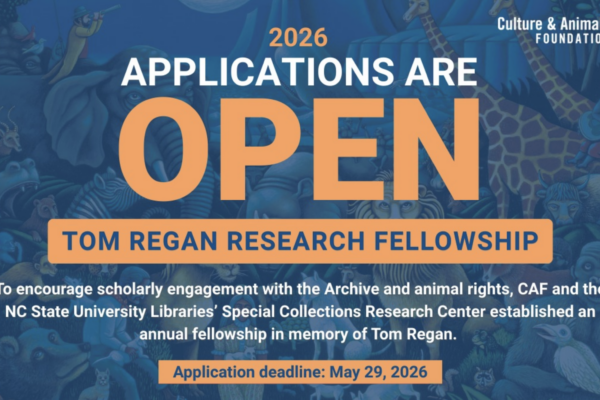
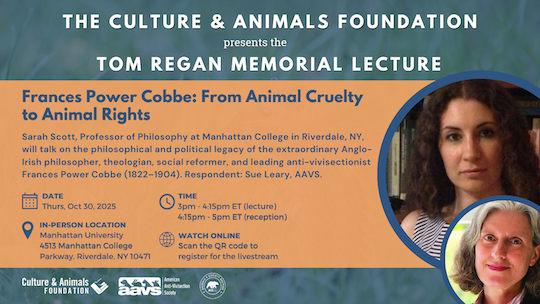
CAF started small, supporting arts events and vegfests in the Raleigh area, and occasionally sending checks to artists. In 1990, Tom and Nancy began a seventeen-year run of annual conferences, which brought scholars, activists, and artists together for a unique weekend of learning, camaraderie, and vegan food. In 2008, CAF switched wholly to making annual grants. Then, when Tom died in 2017, CAF added an annual lecture and an annual fellowship in his name, and in 2021 an arts prize in Nancy’s. Since then, we’ve created an audio-documentary series (Martin’s Act@200) and are conducting oral history interviews.
It was a very different activist and academic landscape for animals in 1985. Activism concentrated on animal abuse in science, “entertainment,” and clothing. That year, for instance, advocates, including Tom, occupied the National Institutes of Health for four days to protest brain-trauma experiments on monkeys, and Greenpeace UK produced its video Dumb Animals and PETA released Unnecessary Fuss in 1984.
Consideration of animals raised for food and promoting veganism were not front and center. Whereas 1985 saw the Farm Animal Reform Movement’s first Great American Meatout, it was not until the following year that Gene Baur and Lorri Houston would rescue Hilda the sheep from a dead pile and found Farm Sanctuary, or Edensoy would manufacture soy milk in the U.S. Carol Adams’ The Sexual Politics of Meat, for which CAF gave a research grant, was five years away, as was the March for the Animals in Washington, DC. Mercy for Animals, Compassion Over Killing, and a host of other advocacy groups weren’t even twinkles in their founders’ eyes.
The broader scholarly work known as Human–Animal Studies (HAS) was also in its infancy. Between the Species produced its first issue in 1985, which also saw the publication of the book In Defense of Animals and Jon Wynne-Tyson’s The Extended Circle: A Dictionary of Humane Thought. (When the latter was published in the U.S. in 1989, its subtitle changed to A Commonplace Book of Animal Rights.) Animal Law courses were few and far between, and the Nonhuman Rights Project wouldn’t be registered until 1995.
Since then, HAS has flourished, and CAF’s grants have followed. We now support scholars in Anthrozoology, Animal Studies, Critical Animal Studies, Vegan Studies, and Animal (Rights) Law from all over the world, along with those studying animals in subdisciplines throughout the social sciences and humanities. As this journal/annual report demonstrates, the arts has seen a similar explosion in how artists reflect on nonhuman animals. Multimedia and interdisciplinary thinking are bringing science and scholarship to creativity.
Beyond these welcome developments, scholars and artists are recognizing that our collective failure as a species to understand, honor, and protect the lives of nonhuman others is a failure not only of public policy, economics, and political engagement, but imaginative story-telling, curiosity, and empathy. It was Tom and Nancy’s mission forty years ago to employ the arts and scholarship to stimulate these. We hope you find the contents of our annual report proof of our efforts to continue and expand that mission.