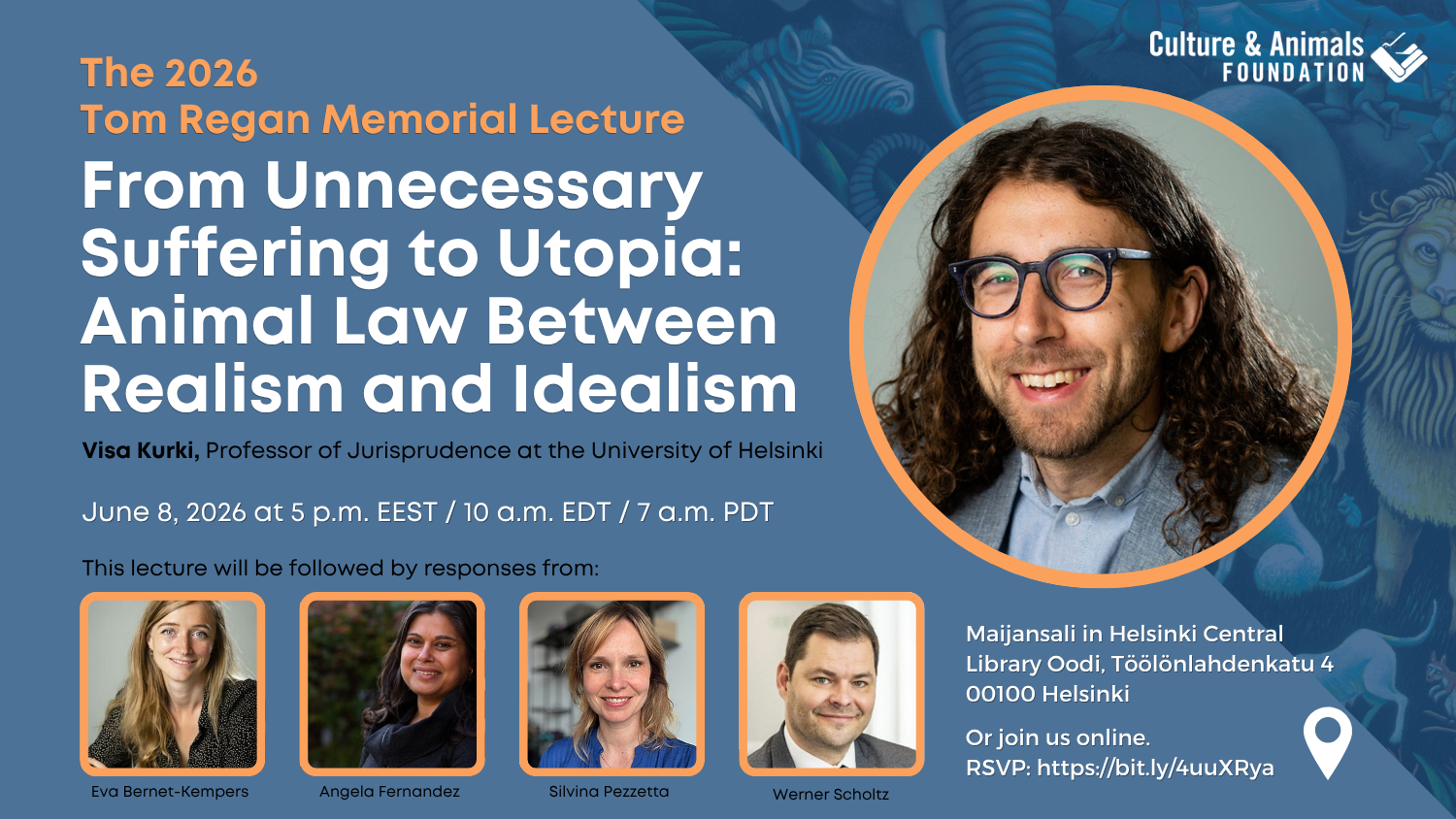
Visa Kurki, Professor of Jurisprudence at the University of Helsinki, will deliver the eighth annual 2026 Tom Regan Memorial Lecture on June 8th, 10:00 a.m. EDT.
The title of Visa’s lecture is “From Unnecessary Suffering to Utopia: Animal Law Between Realism and Idealism.” It will be followed by responses from (left to right):
- Eva Bernet-Kempers, Postdoctoral Researcher Animal Law, University of Antwerp, Belgium
- Professor Angela Fernandez, Director of the Animal Law Program, Henry N. R. Jackman Faculty of Law, University of Toronto, Canada
- Silvina Pezzetta, CONICET, UBA, Visiting Researcher Università degli Studi di Milano-Bicocca, Italy
- Werner Scholtz, Head of School and Professor of Global Environmental Law, University of Southampton, U.K.
The premise of the lecture is as follows:
Animal law is becoming an established field of academic study. However, its relationship to practice is complicated. Can animal law scholarship produce results that are both agenda-setting and useful for animal law practice and activism?
The lecture will distinguish three main types of animal law scholarship: practically oriented black-letter scholarship; ideal normative scholarship, with close connections to ethics and political philosophy; and conceptual scholarship, focusing on analyzing the relevant legal categories and concepts.
I will outline these three types, arguing that all of these types of scholarship need each other. Black-letter scholarship is mostly confined to the welfarist regime and its prohibition of unnecessary suffering. Such scholarship is needed for practical relevance, but may lose sight of the big picture. Normative scholarship is needed to set the agenda, but it may get rather utopian and thus detached from practice. Conceptual scholarship helps us understand where we are and what the current legal constraints truly are. Both black-letter and ideal scholarship may be bound by assumptions about the legal status of animals or relevant legal concepts. For instance, the normative content of the abolitionist approach has been informed by a conceptual analysis of the welfarist regime. Thus, challenging or revising that analysis may very well have an impact on the proposed normative agenda.
The three types of scholarship should also interact when designing strategies to benefit animals. “Strategic litigation transplants”, where strategies to improve the legal status of animals are imported from one country to another, will need careful analysis of whether the strategy can successfully be exported to a different jurisdiction. Habeas corpus trials have had more success in certain Latin American countries than in the United States, where they originated. On the other hand, such a legal strategy is virtually unthinkable in many European civil-law countries. Litigation on behalf of animals will need an analysis of the status quo; an agenda for where we need to go; and a strategy of how to get there. Black-letter, normative, and conceptual scholarship will all play a part in this.
The lecture will take place as part of the 2026 Helsinki Animal Law Conference. The lecture will be in person and online (details below). Attendance for the lecture, online or in person, is free of charge.
Details of the event are as follows:
Date: Monday June 8, 2026
Time: 5 p.m EEST // 10 a.m. EDT / 7 a.m. PDT
Place: Maijansali in Helsinki Central Library Oodi, Töölönlahdenkatu 4 00100 Helsinki
To register, click here.